
Does Homeowners Insurance Cover Roof Replacement?
Insurance usually pays for roof damage from storms, hail or fallen trees, not old age. How ACV vs. replacement cost, roof age and deductibles change the payout.
Published Oct 27, 2026. 3 min read.
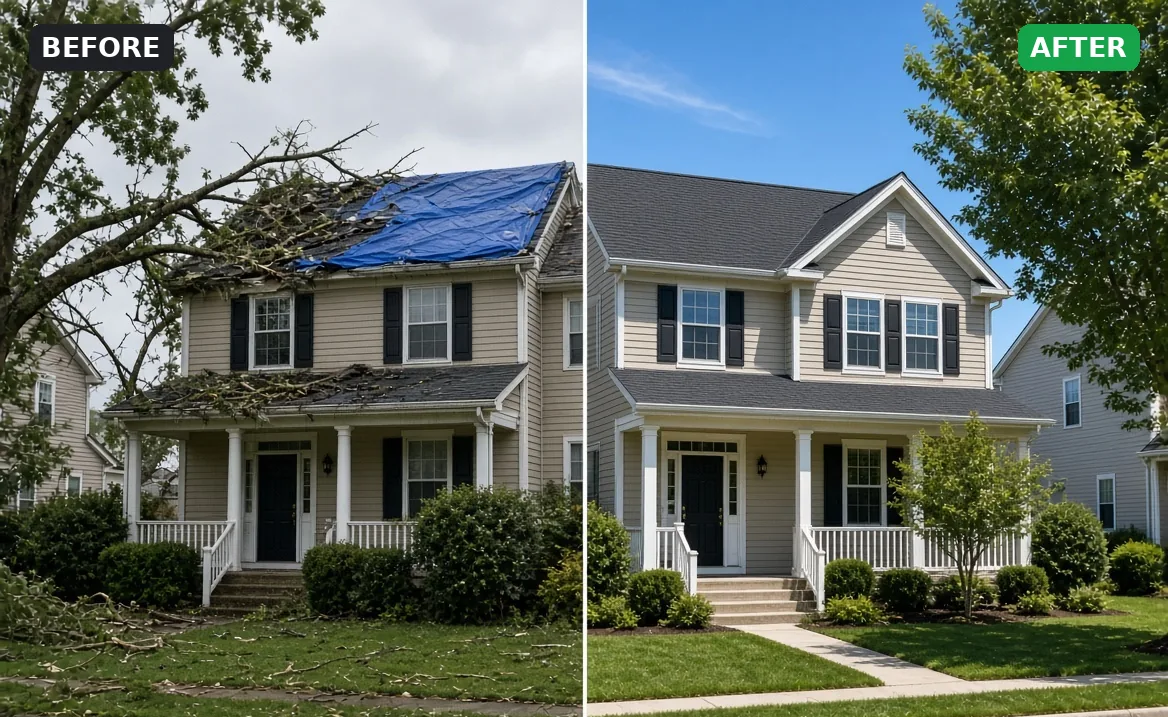
Homeowners insurance usually pays to repair or replace a roof when the damage is sudden and accidental — wind, hail, a fallen tree, fire. It does not pay to replace a roof that is simply old or worn out. How much you get back depends on your policy type, your roof's age and your deductible.
What is usually covered
- Wind and storm damage, including blown-off shingles
- Hail damage
- Falling trees or branches
- Fire and lightning
- Interior water damage caused by a covered roof claim
What is usually not covered
- Normal wear and tear, or a roof at the end of its life
- Damage from poor maintenance (clogged gutters, long-ignored leaks)
- Mold, rot and pests
- Bad installation or manufacturing defects (these may fall under a contractor or manufacturer warranty instead)
ACV vs. replacement cost: why it matters
Replacement cost value (RCV) pays what it costs today to repair or replace the roof, minus your deductible. Actual cash value (ACV) subtracts depreciation for the roof's age first. On an older roof, an ACV policy can pay far less than the cost of a new roof.
Some insurers also use a roof payment schedule that pays a smaller percentage as the roof ages, or switch older roofs to ACV at renewal. Check your declarations page for the words "actual cash value", "roof surface" or "payment schedule".
How roof age changes coverage
Many insurers inspect roofs over about 15 to 20 years old, limit the coverage, or require replacement before they renew the policy. If you are buying a home, ask about the roof's age before you buy insurance.
Watch the deductible
Many policies in hail- and hurricane-prone states have a separate wind/hail or hurricane deductible that is a percentage of your home's insured value — often 1% to 5%. On a home insured for $300,000, a 2% deductible is $6,000, which can be more than a small repair.
How to file a roof claim
- Make sure everyone is safe, and cover any opening with a tarp to prevent more damage. Keep receipts.
- Take photos and video of the roof, the yard and any interior damage.
- Call your insurer or file online as soon as you can.
- Meet the adjuster at your home and point out all the damage.
- Get your own written estimate from a licensed local roofer.
- Review the settlement: the payout, deductible and any depreciation.
Beware of storm chasers
After big storms, out-of-town crews knock on doors offering a "free roof". Red flags: pressure to sign right away, asking you to sign over your insurance check, or offering to "cover" your deductible (which can be illegal in some states). check the contractor's license and get more than one quote.
Compare the insurance estimate with real quotes
The adjuster's estimate and your roofers' quotes should describe the same work. Use our free quote comparison to see what each quote includes, and our cost estimator for a typical price in your area.
Frequently asked questions
Will insurance replace my roof because it is old?
No. Age and normal wear are not covered. Insurance pays for sudden damage from a covered event like wind or hail.
Will my premium go up after a roof claim?
It can. Rules vary by insurer and state. Ask your agent before filing a small claim that may be close to your deductible.
What if my roof claim is denied or too low?
You can ask for a re-inspection, send more photos and contractor estimates, appeal in writing, or contact your state's department of insurance for help.
Sources
- Insurify — What does roof insurance cover?
- SageSure — Will insurance cover a 20-year-old roof?
- Bankrate — Does homeowners insurance cover roof replacement?
Prices are national ranges for planning only. Your price depends on your home, your region and the contractor. This guide is general information, not professional, legal or insurance advice.
This article is general information, not insurance or legal advice. Your policy's wording decides what is covered.
Related guides
Quote tips
How to read a roofing quote line by line
The total is the least useful number on a roofing quote. Here is what to look for instead.
Oct 22, 2026, 1 min read
Project planning
Repair or replace your windows? A simple way to decide
Foggy glass and drafts don't always mean new windows. Here is how to tell.
Oct 24, 2026, 1 min read
Cost guides
How Much Does a New Roof Cost? (2026 Prices)
A new asphalt shingle roof usually costs about $4.50 to $11 per square foot installed. See what drives the price and how to check your quotes.
Oct 27, 2026, 4 min read